Sunday, May 17, 2015
Morning Fog and Apple Blossom Festival Breakfast
Monday, January 5, 2015
Recent Photos


Wednesday, May 15, 2013
It Soars...!
He was gliding his Lambada motor-glider across the Shenandoah Valley. Down to about 2,000 feet he flew from sink into lift under a cloud street and began climbing, and climbing, until topping out at over 10,000 feet. From that height it feels like you rule the world, and a Lambada gliding at close to 30:1 could cover 60 miles in no wind conditions. (Less into the wind and more with the wind)
Jeff and I had taken many soaring flights in the Lambada. To keep the engine warm, and available, we would fly around with the throttle set to an RPM that would give zero thrust. Soaring upwards in thermals and descending in areas of sink. For hours at a time. All the while burning very little fuel from the Rotax 912.
I could do this with the Challenger! It has demonstrated many times that it will climb with the engine at idle. On a flight earlier this year I played around for a little under a cumulus cloud climbing with the engine at a low power setting.
Checking Dr Jacks BLIPMAP forecast on Monday night gave an encouraging forecast for soaring across Central NY with 700 fpm thermals.
At the airport there was little sign from the ground that soaring was any good. Cirrus had just passed overhead cutting off some of the solar heating but it was moving off to the east. There were no cumulus clouds in my line of sight.
It was kind of warm in the sun with a light breeze. Not wanting to feel too warm in the greenhouse Challenger, I left my jacket in the car. Besides I wasn't expecting to go high enough to get cold.
After take-off I climbed to 3,000 and reduced power enough to yield a gentle descent. (On a calm morning I will work out the best RPM for this) Gliding at 45 mph I hadn't lost more than a few hundred feet before coming into some lift. I immediately rolled into a turn and began feeling around for the core of the thermal.
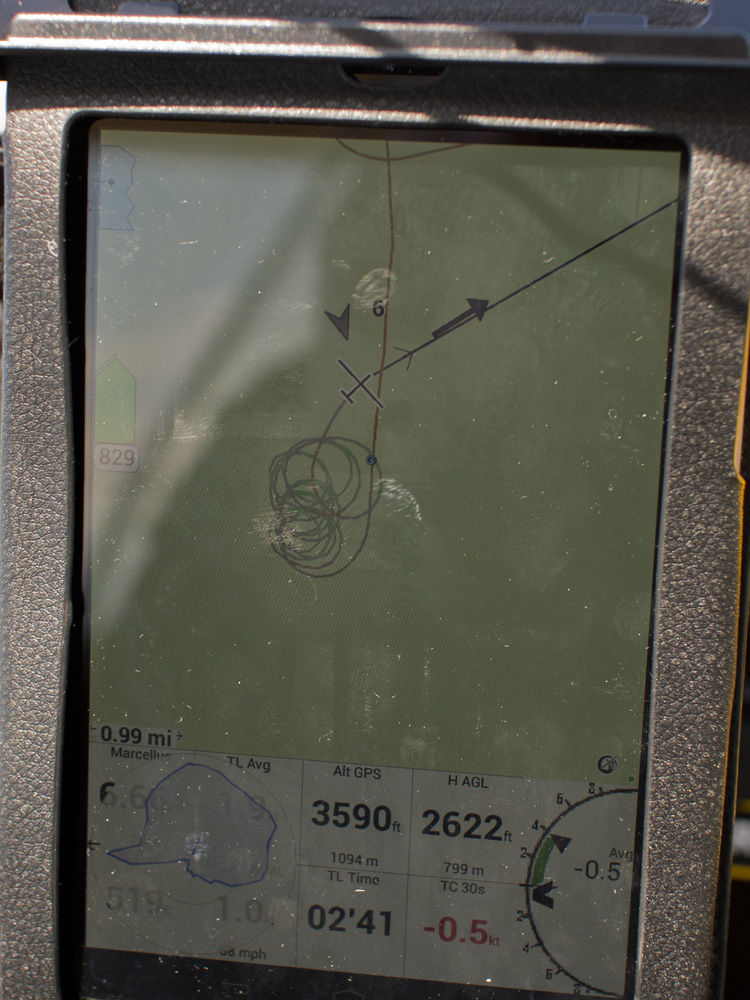
I'm using a Google Nexus 7 android tablet running XCSoar software that draws its GPS data from a Dual bluetooth GPS. This gives very accurate positioning compared to the Nexus's internal GPS which is good for lateral position but has a much higher error in altitude.
As the plane begins circling the map displayed by XCSoar changes to a screen dedicated to thermalling. It zooms in and shows your path and also calculates drift for an estimate of the winds at that altitude.
As I climb it is obvious that this thermal is strong enough to carry me upwards without any help from the engine. Not yet ready to turn the engine off so I throttle back to almost idle. Just enough RPM to keep the engine smooth and I continue upwards.
At times I see over 600 FPM !
Reaching 5,400 feet I wished I had warn my jacket! It was getting cold. The lift is dying out and I turned west into the wind in search of the next thermal. Here is where I need to figure out the best power setting for between thermal gliding. At near idle my glide ratio is somewhere about 10:1 at 45 MPH. On a strong day with high cloud base that might be good enough, but on a weaker day some help will be necessary. Enough power to allow a 20:1 ratio will make staying aloft all afternoon possible. The season is early and I'll soon work out a couple solutions for different conditions.
Short of the airport and down to 1,000 feet AGL I throttled up and cruised back home happy to find that, yes, I can soar in my Challenger II.
The flight lasted 48 minutes and I burned 1.2 gal of auto gas...
Saturday, March 23, 2013
Early Season Flight
This was my first opportunity to fly since mid January. I've been watching the 10 day forecast for over a month now and always it predicts a sunny, above freezing stretch sometime in the following week. As the following week arrives, the good weather moves to the next week.
Today was nice. The rest of the week is forecast to be cloudy with snow showers. But "next week", good weather....
Sunday, September 30, 2012
Returning to a Challenger II
A few years back I had the opportunity to purchase a Cessna 150 with my friend Kate. I saw this as an opportunity to fly without the need to assemble/disassemble or to be dependent on tow pilots or soaring weather. Now I could cruise places.
At the time, fuel was about $4.00/gal so with a plan to throttle back to less than 5 gph I could keep flying costs low.
Almost immediately I found that our little Cessna's engine didn't like lugging around at 2200 rpm. Plugs were fouling, and at run-up we were seeing excessive rpm drops. On advice from our mechanic I kept the rpms up. This solved the problem with plugs but brought fuel burn up to over 6 gph. Over the past couple years fuel prices have risen to over $6.00/gal.
At this rate flying wasn't unaffordable, but I wasn't feeling like I could just go up for no reason other than 'it was a nice day'.
About 6 weeks ago there was a note on my hangar door with a phone number. One of the local pilots had bought a Challenger and wanted me to ride along with him until he was feeling comfortable. I instructed in a Challenger back in the 90s but hadn't flown in one since 2000. They aren't at all difficult to fly, but they do fly a little different from regular aircraft and it takes some getting used to.
We took a few flights together and he did just fine. However for personal reasons he decided he would take a break from flying and wanted to know if I was interested in buying the plane. At first I said no, but after a couple flights alone I knew buying the plane would be a good decision for me.
I immediately felt at home in this plane. Though quite a bit heavier than the Challenger I built, it still had the familiar feel of the plane I had spent 600 hours in.
With the doors off, my camera has an unrestricted view to the lakes and farmland of Central New York. Fuel burn appears to be extremely low and I think hourly cost for fuel and oil might be between $10-15/hr cruising at 70+ and under $10/hr when lazily floating along at 45-50 mph. My last flight a few days ago was for 1 hour with 2 takeoffs and a climb to about 3,000'. During this flight 1.7 gallons of auto fuel was drawn from the tank. Not bad at all!

Wednesday, December 21, 2011
Last Fight of Season
Once the snow accumulates at our grass field here in Marcellus we are done. A couple years back the owner stopped plowing and sold the snowplow. We do have a few pilots that mount skis and continue right through the winter. Someday I'd like to do that. In a few days we will close up the hangar, sealing it with insulated panels until spring.
It couldn't have been a more perfect day for what will likely be our last flight of the season. The air was smooth and visibility very good. High clouds radiating across the sky thickening to the west with the approach of our next storm.
With the sun low in the sky, the ground below was dark. Much darker than the sky. The contrast was too much for my camera and as a result either the sky was blown out with no color or the ground was near black. I tried an HDR with 3 shots but even at 75 mph there was too much movement for the images to align properly. Instead, in Photomatix, I created a pseudo-HDR using one image. Not quite the same quality as with a series of 3 or 5 shots, since in this shot the dark area have to be lightened so much that noise is beginning to show. I still like it...
Looking west across 5 of the Finger Lakes in Central New York. Otisco, Skaneateles, Owasco, Cayuga and Seneca (just a sliver below the horizon)
Looking south across Kate's Otisco Lake.
The town of Skaneateles at dusk.
HAPPY HOLIDAYS TO ALL !
Thursday, October 27, 2011
Fall Colors and Waterfalls
Taughannock Falls
Carpenter Brook - upper falls Carpenter Brook - middle and lower fallsSaturday, June 11, 2011
First Flight of Jeff's Schleicher ASK-14

Assembly went quite well with no real problems. For the summer it will remain assembled and hangared.

Willie and Jeff connecting the ailerons.


Before towing out to the runway Jeff spent some time getting comfortable in the cockpit. Then after a little trial and error with choke/throttle combinations the engine was started. It has a 4 cylinder 2 stroke Hirth engine of 28 HP.

On the runway and ready to go!

Lift-off...

A good omen!

I flew our 150 over from Marcellus so we could do a little air-to-air. Circling outside the thermal as Jeff was in lift, he easily out-climbed my 150 turning in sink or even neutral air.

For Jeff's first flight I kept a good distance away or above. We'll get together again soon for some closer photo work.


Jeff's flight lasted about 40 minutes, rolling to a stop just a short distance from his hangar. This is one sweet little glider. His smile says it all!