Sunday, July 14, 2013

2013 Rose Fly-in - EAA Chapter 1017

For almost 20 years Chapter 1017 has had a fly-in at Rose airport about 5 miles south of Sodus Bay on Lake Ontario.

It is a relatively small event attended by club members and a few visitors who fly in and camp for the weekend. I didn't camp but flew up from Marcellus on each of the three days during the event. Not that I need an excuse, but it is a great excuse for some flying.

The atmosphere is perfect for a relaxing visit with other club members and meeting with visitors. There is a camping area under a grove of trees with plenty of room for RVs or tents. Water and bathroom facilities are available on-site as well as picnic tables under a tent for visiting or eating. Breakfast, lunch and dinners are prepared on request and priced very reasonably.

After months of rain, the weather pattern changed leading up to the event giving us pretty good conditions right through the weekend. Winds were fairly light and high clouds Friday and Saturday limited the sun's heating making afternoon temperatures tolerable and cutting off thermals for very smooth flying.


(Click on images for full resolution)

The town of Rose with the airport in the background Friday afternoon.

Shortly after my arrival, Gerd, Bill and Guy arrived. This was Guy's first X/C in a Challenger and as you can see he is pretty happy.

Four Challengers in a row! 
We are fortunate as there are 5 Challengers based at Marcellus

Charlie Tyler checking out my re-drive.

Murphy Rebel

Another nice way to cool off...

Saturday's Flight

On the way to Rose I made a brief diversion to circle over the site of a wedding later in the afternoon on the shore of Otisco Lake. My partner in a Cessna is also the Town Justice of Marietta and she was performing the ceremony


Michael, who is also a Challenger owner came along for the ride. Skaneateles Lake is in the background

A group of kayakers on the Seneca River near Howland Island Wildlife Area

A nice turnout as we arrive on Saturday afternoon

Camping out of an Aeronca Champ

Downloading navigational software


Time for stories and jokes along the flight line...

Campground panorama


Sharon has spotted someone...

Dinner time. 
Here our chef is preparing a couple "Charlie Tyler Double Trouble Burgers"

Demonstrating XWing Pro


Flying home. Smooth as glass!

Sunday

Youngster getting a ride in a trike.

CGS Hawk flying north.

On the way out I took the long way back and flew north for a bit along Sodus Bay and over Chimney Bluffs State Park before turning southeast and continuing my climb into much cooler air above the clouds.

Sodus Bay on Lake Ontario

Chimney Bluffs State Park

Cool and smooth above the clouds for the ride back.

A very nice weekend. Thank you to all the members of EAA 1017 for all your hard work making this annual even happen!


Monday, June 3, 2013

Michigan to Central New York in a Challenger I

A couple weeks back Michael Haley found a Challenger I online that looked promising. A few of the Challenger owners at Marcellus Airport (NK71) met with him one evening to look at pictures and documents sent by the then current owner.

Very quickly the opinion among our group was that this nice looking plane was in good shape and well cared for. The engine had recently been overhauled with only 11 hours logged since then.

Michael decided he should move forward with purchasing this plane and began talking about disassembling and transporting it back to New York. I said, "It's only in Michigan. Why don't we just fly it back? How far is Michigan anyway?" Michael asked if I would be interested in flying it. "Sure", was my response.

That evening I used SkyVector.com to quickly map out the flight. At this point not knowing where in Michigan the plane was located I picked a point in the middle of the state giving me a mostly straight flight to New York. It turns out the plane was located at East Jordan, MI (Y94) which is further north in the state, almost to where Lake Huron and Lake Michigan meet.

I've flown across the country from west to east and a couple times south to Florida in light aircraft but had never flown more than 100 miles in something like a Challenger. Flying hundreds of miles in light aircraft is always an adventure. In something the size and speed of a Challenger, EVERY FLIGHT anywhere is an adventure!

Since purchasing my Challenger II last fall I had thought about making a long flight. With no storage space, carrying enough 2-stroke oil and a few tools, not to mention a little luggage becomes a challenge. Over the winter I made a fabric pouch that hangs between the rear seat and the fuel tank. In this I can carry about 12-8 oz oil containers and a few tools. With a full tank and what oil I could carry, there would be enough oil to mix with Avgas for 15 hours of flying at 60 mph or about 900 miles.

Thus one of my first questions about the flight was about carrying oil. Michael would be driving back as I flew but there were points along the route where our paths would be separated by quite some distance as I take either a more direct route or longer route to avoid Mode C airspace. If the winds were favorable, and they weren't, I would make much better time leaving him far behind. Oil needed to be carried in the aircraft with me to avoid long delays.


Now it was just a matter of watching the weather for a window to make the flight and getting the free time needed.

Fortunately we didn't need to wait long. As Memorial Day weekend approached a low pressure system was in the process of slowly moving out of NY while high pressure was building over Michigan and Ohio holding off the next system just to the west.

We left Saturday morning when I got off the night shift with Michael driving. Taking a shortcut across Canada from Buffalo to Port Huron saved us a couple hours getting us to East Jordan airport before sunset. They are on the western end of the eastern time zone and thus we were given an extra 1/2 hour of light.

We looking over the plane and it was indeed in very good shape. There were a couple small items that I felt needed attention before departing. The rudder felt quite stiff and squeaked when moved. After oiling everything I inspected the rudder cables and found them as tight as guitar strings. Shellie loosened the turnbuckles and that fixed it. Also the re-drive belt was too tight. Other that that, we seemed ready to go. Shellie, the current owner, had found spots to secure 3-32 oz containers of oil. More than enough for the flight.

 Shellie and his wife Cyndy opening a hatch in the nose for access to the rudder turnbuckles.

Michael


We woke early the following morning, ate a quick breakfast and headed to the airport. Shellie already had the plane pulled out of the hangar. I busied myself mounting my Dual Bluetooth GPS, Google Nexus tablet and a Spot Satellite Messenger while Michael and Shellie took care of the necessary paperwork.


After a final check of the plane, I climbed in and taxied out for a ride around the pattern before heading south. Everything seemed fine and the airplane flew with the enthusiasm I expected, being a single place powered by the same engine as my 2 place. Saying goodbye, I departed and made a broad circle of the field as the airplane climbed to cruising altitude.


East Jordan City Airport

East Jordan and Lake Charlevoix with Lake Michigan beyond


Me, in flight.


Settling in on cruise I began thinking about fuel consumption. There is no fuel gauge installed on the plane and the previous owner never accurately calculated fuel usage during cruise. My Challenger burns about 2.8 gph at an easy cruise about 60 mph, but I've heard stories of 3.5-4.5 gph. After some quick math I realize I might barely make my first planned fuel stop if it turns out to be at the high end of this range! 

An extra stop to visually check fuel will be necessary. About an hour and a quarter after leaving East Jordan I stopped at Gladwin Zettle (KGDW) to find about 4 gallons drawn from the 12.5 gallon tank. That means a little under 3 gph in cruise. Perfect! On to Owosso (KRNP). 

Approaching Owosso I decide instead to stop at Prices (9G2). This puts me within miles of RT 23 that Michael will be driving on. This turned out to be a very good decision...

It won't start!

After fueling up, the engine won't start. I let it crank for a while. I tried different throttle positions. Even primed. Nothing. No spark. A call to Shellie for suggestions, then finally Michael who fortunately wasn't too far away at that point.

While waiting, I pulled the plane away from the pumps and over to a tie-down, as we might be here for a while. A short time later a pickup truck pulled up to a stop next to me and a person I had seen doing some painting by the hangars got out. It is the airport mechanic, and he has experience with Rotax engines. He heads straight for the plugs.

Thank you to this great guy who helped us along the way and changed the outcome of the day


With the help of a universal joint plugged into his drive he was able to get around the heater unit that restricted access to the plugs. He pulled one from each cylinder and cleaned them. They were soaked with gas/oil.

Plugs back in and with fingers crossed, I pressed the starter button. Yes! It started.

Although instructing in a Challenger for 8 years back in the 90's without a problem, I never really trusted these 2-stroke engines. For every flight and almost every moment of those flights in the back of my mind was concern for an engine failure. Fear of this limited me. Kept me close to home. This is one of the reasons that this flight was such a big deal to me. It has reassured me that, yes, you can head out cross country. (with some tools and spare plugs)

When flying I always watch for suitable fields and fly at an altitude that will give me ample gliding range to make a safe landing.

Of course, engine failures may occur at some point, but fear of this is just not worth missing out on all the great adventures that wait for us out there.

Prices airport. A fly-in community.

With an additional 6 gallons of fuel I head out on a southwesterly heading to rejoin my track and work my way around the 30 mile radius of the Detroit Mode C airspace before turning southeast and directly over Toledo.

Chrysler Proving Grounds near Detroit.

Creek meandering though farmland towards Lake Erie

Toledo, OH

Cruising at 6,500 feet in smooth air I feel comfortable overflying this developed area. Squeezing between the Detroit and Toledo Mode C airspaces I get a nice view of downtown Toledo.

It was about 40 minutes to Sandusky and another 40 or so to Ashland, OH (3G4). This brings me to over 3 hours since the last fueling. Time for a stop. Descending into Ashland it is beginning to feel like a long day already. Obviously I will not make Dunkirk before evening so I might as well stop here for the night.

Descending into Ashland with 3:07 on the E.I.S.


Upon landing I am greeted by a couple who have a Grumman on the field. They open the office for me and bring me a glass of water and offer some cake. Hoping to loose a few pounds now that winter is over, I decline. Carrot cake? My favorite. I will take a piece.

Michael is only about 15 minutes away. As I finish my cake they bring me over to show me their hangar. They have done a bit of work and turned it into a comfortable hangout. Carpet, chairs and refrigerator. All the comforts of home for their plane named Taz.

Michael arrives and is shown some recent engine work

It turns out to be a good decision to have stopped here for the night. By the time we tie down the plane, drive into town for dinner and find a hotel it is getting late. By tomorrow the winds across New York should have died down with the low that lingered over the eastern part of the state moving northeast.

During the night the high pressure over Michigan has moved to the east allowing moisture from the next system to move eastward. The Weather Channel, aviation weather online and finally, stepping outside the door confirmed this with showers visible just to the southwest of our location.

We don't waste any time and head out, stopping at McD for a quick bite to eat. Driving to the airport I receive a text message with a picture of Wilmington, NY with 3 feet of snow. Snow was in the forecast for the mountains of northeast New york but I assumed it was going to be more like a few inches. In less than 2 weeks I will be camping and hiking in that area!

At the field the airport manager came out to greet us and pumped 6 gallons into the plane giving me about 10 gallons for the next leg. (Early on I decided that to keep oil calculations simple by just adding multiples of 3 gallons to the tank)

With cautious priming the engine started and as I taxi out a light rain is beginning to fall. In the air the precipitation is like a curtain to the south of me as I head out on course. In the distance to the north and east the skies are lighter with sunshine at the horizon.


For over an hour Cleveland is visible almost 50 miles in the distance as I first head SSE then ENE rounding the Akron Class C airspace.


Looking ahead along the route to the BSV VOR which at this point is still 30 miles ahead. Note the rain drops on the windshield. Timing for this trip couldn't have worked out better. If we were any earlier or later, weather would have been a big problem.


After rounding the Akron airspace my next stop was Port Meadville, PA (GKJ) for fuel. Again concerns over starting hot are on my mind.

After quite a bit of cranking and waiting, the engine fires and I'm on my way toward my final fuel stop in Dunkirk, NY.


Just west of Dunkirk I head out over Lake Ontario, both to line up a shot of the town, harbor and the airport and also to enter downwind for runway 33. Several other aircraft are already in the pattern and I circle over the lake once before joining the downwind leg to provide adequate spacing.

A beautiful Waco on the ramp.

Another hard start, but I was confident it would. Final leg to Marcellus. On the last half of the leg into Dunkirk it was getting bumpy at altitude and it had me thinking there was some wind sheer over 5,000 feet. Now it was quite bumpy down low too.


Passing Letchworth I got tired of the rough ride and climbed to 6,500' where things finally smoothed out. This gave me a nice view over the Finger Lakes towards home.

Looking east over Canandaigua, Seneca and Cayuga Lakes

Finally home to Marcellus!


About 650 miles and over 12 hours of flying. What a way to spend a holiday weekend!
A great experience, and as always I met many friendly, helpful people along the way.

And, yes, you can fly a Challenger over some serious distance. All you need is the time.
It isn't much faster than driving, but WAY more fun!


Wednesday, May 15, 2013

It Soars...!

I was inspired to try some soaring in the Challenger after a call from my friend Jeff in Virginia a few days ago.

He was gliding his Lambada motor-glider across the Shenandoah Valley. Down to about 2,000 feet he flew from sink into lift under a cloud street and began climbing, and climbing, until topping out at over 10,000 feet. From that height it feels like you rule the world, and a Lambada gliding at close to 30:1 could cover 60 miles in no wind conditions. (Less into the wind and more with the wind)

Jeff and I had taken many soaring flights in the Lambada. To keep the engine warm, and available, we would fly around with the throttle set to an RPM that would give zero thrust. Soaring upwards in thermals and descending in areas of sink. For hours at a time. All the while burning very little fuel from the Rotax 912.

I could do this with the Challenger! It has demonstrated many times that it will climb with the engine at idle. On a flight earlier this year I played around for a little under a cumulus cloud climbing with the engine at a low power setting.

Checking Dr Jacks BLIPMAP forecast on Monday night gave an encouraging forecast for soaring across Central NY with 700 fpm thermals.

At the airport there was little sign from the ground that soaring was any good. Cirrus had just passed overhead cutting off some of the solar heating but it was moving off to the east. There were no cumulus clouds in my line of sight.

It was kind of warm in the sun with a light breeze. Not wanting to feel too warm in the greenhouse Challenger, I left my jacket in the car. Besides I wasn't expecting to go high enough to get cold.

After take-off I climbed to 3,000 and reduced power enough to yield a gentle descent. (On a calm morning I will work out the best RPM for this) Gliding at 45 mph I hadn't lost more than a few hundred feet before coming into some lift. I immediately rolled into a turn and began feeling around for the core of the thermal.

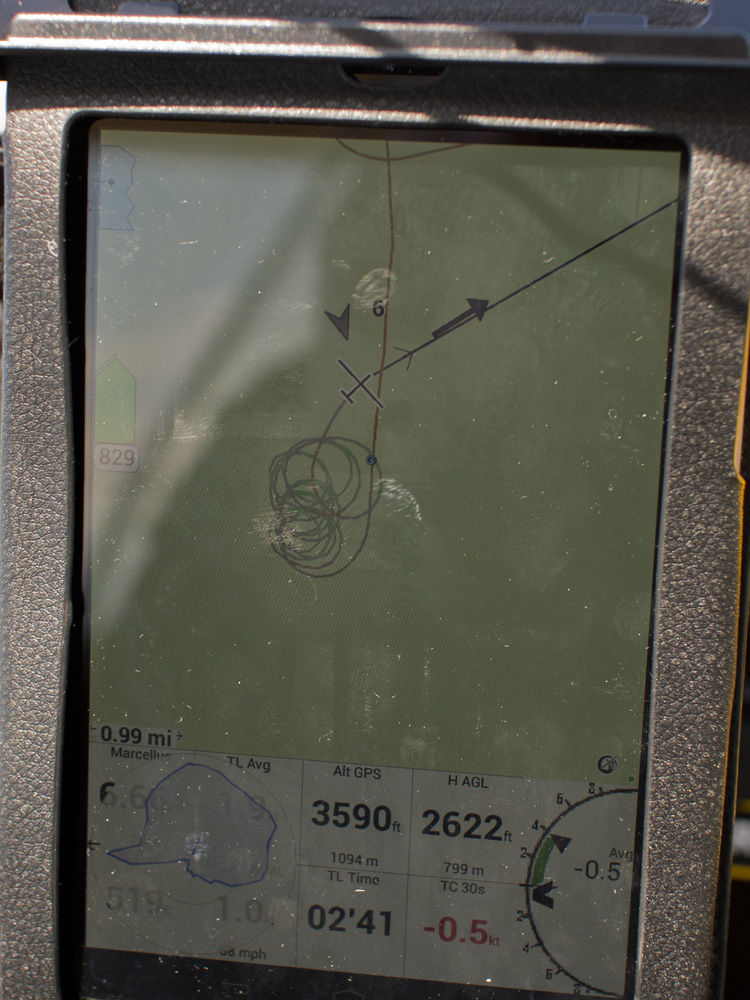
I'm using a Google Nexus 7 android tablet running XCSoar software that draws its GPS data from a Dual bluetooth GPS. This gives very accurate positioning compared to the Nexus's internal GPS which is good for lateral position but has a much higher error in altitude.

As the plane begins circling the map displayed by XCSoar changes to a screen dedicated to thermalling. It zooms in and shows your path and also calculates drift for an estimate of the winds at that altitude.

As I climb it is obvious that this thermal is strong enough to carry me upwards without any help from the engine. Not yet ready to turn the engine off so I throttle back to almost idle. Just enough RPM to keep the engine smooth and I continue upwards.

At times I see over 600 FPM !


Reaching 5,400 feet I wished I had warn my jacket! It was getting cold. The lift is dying out and I turned west into the wind in search of the next thermal. Here is where I need to figure out the best power setting for between thermal gliding. At near idle my glide ratio is somewhere about 10:1 at 45 MPH. On a strong day with high cloud base that might be good enough, but on a weaker day some help will be necessary. Enough power to allow a 20:1 ratio will make staying aloft all afternoon possible. The season is early and I'll soon work out a couple solutions for different conditions.


Fortunately I didn't need to glide far for the next thermal, because I was down to under 2,500 feet in sink just north of Skaneateles. Climbing in lift I didn't make it as high this time before heading back towards Marcellus. Beginning my glide XCSoar indicated I would arrive at Marcellus with 400 feet to spare. That was before running into sink...

Short of the airport and down to 1,000 feet AGL I throttled up and cruised back home happy to find that, yes, I can soar in my Challenger II.

The flight lasted 48 minutes and I burned 1.2 gal of auto gas...

Monday, May 6, 2013

Visit with Iroquois Soaring at Hamilton

This was my first cross-country flight of the year. It was a beautiful warm day and perfect for a flight with the doors off to make a visit with my friends at Iroquois Soaring in Hamilton.

The club has been much more active in recent seasons with new members adding to the enthusiasm of the already great bunch that have been with the club for years.

Though it seemed there would be plenty of fuel for the flight and maybe a couple rides with friends I was visiting, I didn't want to fly the last leg staring at the fuel quantity on the panel display. So it was either bring 2-stroke oil and buy aviation fuel at close to $7.00 /gal at Hamilton, bring the 5 gallon gas can and walk to the gas station just off the airport property or, bring a my own non-ethanol fuel along for the flight. I chose to bring my own.

With 10 gallons in the airplane tank and 3 in my 5 gallon can securely belted into the rear seat I climbed to 3,000' and headed southeast to round the Syracuse Class C airspace before turning a little more easterly towards Hamilton.


Settling in to a leisurely 50 kt cruise at 4,700 rpm I relaxed and enjoyed the above normal temperatures that allowed me to remove the doors for clear view of Central New York below.

Crossing RT81 just north of Lafayette looking south

Once my wheels leave the ground, I am already where I want to be. I'm not in any hurry to arrive at my destination, however I needed to remind myself of that after seeing that my ground speed was only 41 knots due to a 10 kt SE wind at 3,000'. This meant almost an hour for the leg to Hamilton. Almost as long as by car, but way more fun.

Cruising along I  divide my time between watching the earth move slowly below, watching for other traffic and picking fields in the event of an engine failure. We are so fortunate here in CNY. From a reasonable cruising altitude there are many to choose from. So many, that I always say you could close your eyes and the odds are pretty good you will end up in a farmers field.

Airports of course would be the preferred place to glide into and there are quite a few around. Unfortunately many are not on the sectional.

This one just SW of Cazenovia
 Just NW of Hamilton

I arrive at Hamilton and time my entrance into the pattern to fit with traffic already there. I fly a pattern 500' above the field instead of usual 800-1,000' and much closer in. This keeps me out of the way of the faster aircraft, makes fitting in with fast moving planes easier, and places me along their line of sight as they look towards the runway on downwind.

Approaching Hamilton from the west

Looks like Phil walking the wing of ISAs 2-33

Arriving at Hamilton I found Phil working on his SHK, a beautiful wooden 17 (?) meter sailplane that is almost ready to fly. After visiting and catching up we took a short ride in the Challenger with Phil up front to get a feel for how my plane flies.

It does fly a little different from a Cessna. With its ailerons stretching the entire length of the wing they generate a lot of adverse yaw. Turns are made leading with the rudder. Try rolling in with just aileron and the plane will bank, but the drag of that large aileron hanging down into the wind will pull the wing back causing the plane to make a slipping turn.

After our flight I spent a little time watching the glider operations. Brett was towing, Greg running ground operations and Andrew giving rides in the 2-33.

Andrew gave his passenger a thorough briefing on how things work and what to expect on the flight. Greg helped get the passenger belted in.

Andrew piloting from the rear. The front seat, where both students and rides sit has a few that is...breathtaking!
Brett towing in 18L with Andrew and a ride in the 2-33. Greg running wing.

I had to include this shot. The smiles everyone wears says it all.
Turning base to final for the grass along RWY 17.

Soaring was good this afternoon, as I expected from my up and down ride over to Hamilton. I think I overheard Andrew say that after release they climbed in lift to 5,000'.

I miss flying with ISA. Someday when my schedule and time permits I will be back flying with the club.

Time to head out. I add fuel from the 3 gallons brought over with me it's off to Airlane Enterprise (1H1)  
The flight over was beautiful with great visibility I could see into the Adirondack Mountains with its peaks jutting up into the blue sky as well as Frenchman and Dunham Islands on Oneida that is just north of my turn-point.


Approaching Syracuse airspace I had to descend from my comfortable cruise of 3,000 to 1,600' to remain under the Class C airspace. Now I am only about 1,000 above ground and constantly keeping track of the land-able fields below. For the most part of this leg there was always somewhere to glide into. However, one stretch near the west end of Oneida wasn't so generous. But the engine was running smooth and temps were in the normal range. It was only a few minutes, but as always it seemed like forever.


Soon Airlane came into sight and I circled for a picture before landing to the east on the E-W runway. Ray, the owner, came driving out on his ATV as I turned to taxi up the N-S runway towards the hangar to warn me of an area ahead that was still quite soft. I just parked right where I was knowing nobody would be landing on that runway.


After a visit with Ray I headed back out under the Class C on a line just north of Onondaga Lake, over Camillus Airport to Marcellus. With a slight diversion to fly over my Camillus home, where I spotted my wife working in the garden.


Another great little adventure in my Challenger II. I flew for 2.9 hours and burned 6.9 gallons for a GPH of 2.38. 


Saturday, March 23, 2013

Early Season Flight

The field still felt a little too soft to drive on so I parked by the main hangar and walked down to mine. The air temperature was just below freezing with a 10-15 kt NW breeze. 

This was my first opportunity to fly since mid January. I've been watching the 10 day forecast for over a month now and always it predicts a sunny, above freezing stretch sometime in the following week. As the following week arrives, the good weather moves to the next week. 

Today was nice. The rest of the week is forecast to be cloudy with snow showers. But "next week", good weather....

I thought the line of snow/grass so perfectly aligned with the shade of the hangar was interesting.

Looking south towards Otisco and Skaneateles lakes.

The village of Skaneateles as I pass over a snow shower with the snowflakes below reflecting the sun.

Climbing through this large break in the clouds for a look to the west across the town and northern end of Skaneateles Lake.

Descending and looking south at Otisco Lake, still frozen.

Marcellus Airport in the foreground. Syracuse, Onondaga Lake and in the distance Oneida Lake